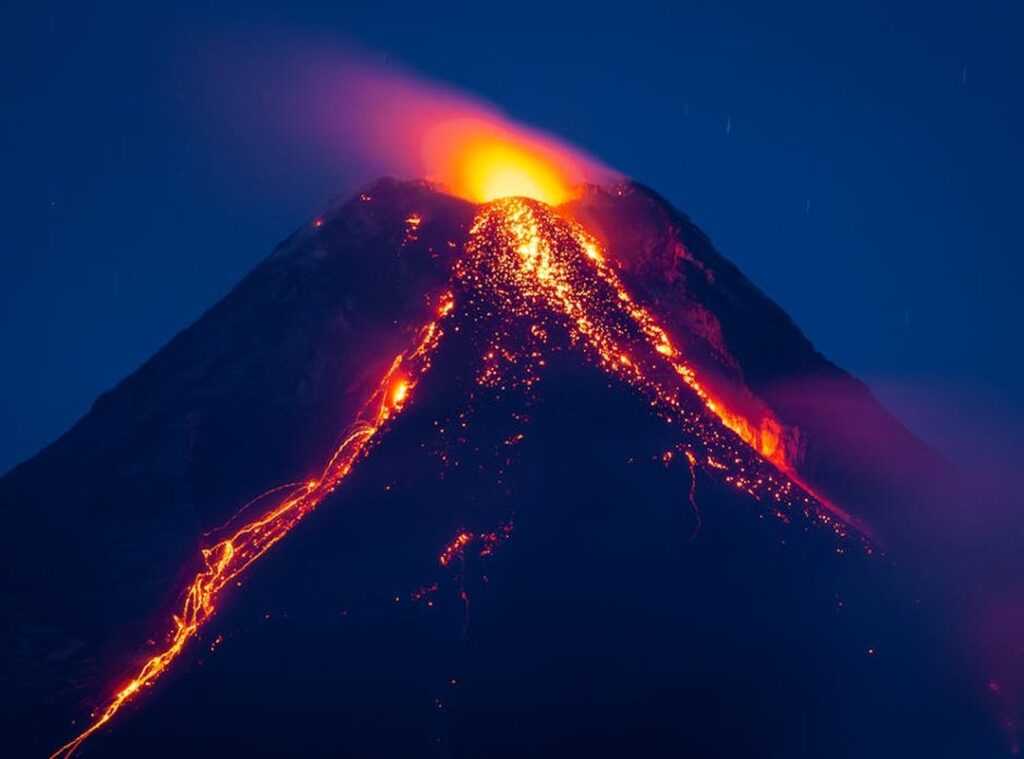
Have you ever wondered what makes a mountain explode with fire and smoke? It’s a question that captures the imagination. This guide will take you on a safe journey deep inside the Earth to uncover the secrets of volcanoes.
Let’s face it, volcanoes are a bit mysterious and maybe a tad intimidating. But don’t worry! This volcanoes kids guide is crafted for curious minds like yours.
We’ll answer all your questions, from “What is a volcano?” to “How do they work?” in a way that’s easy and exciting to understand. Trust us, exploring volcanoes can be fascinating, not frightening.
What’s Beneath Us: Earth’s Hidden Layers
Ever thought about what’s going on beneath your feet? Picture the Earth as a hard-boiled egg. The shell is like the crust, the mantle’s that egg white layer, and deep inside, you’ve got the core, our yolk.
It’s wild how this simple analogy helps us understand what’s really going on.
Now, imagine Earth’s crust as a giant puzzle made up of tectonic plates. These pieces are constantly moving ever so slowly. I mean, you won’t see it happening, but trust me, it is.
And the fun begins. Those movements? They’re like the shifts and grinds of a dance (with dramatic consequences).
Below the crust, there’s magma. Ever wonder what causes those fiery eruptions? It’s this super-hot, melted rock hanging around in the mantle.
When it finds a way out through a volcano, boom! That’s your cue for a science show. Volcanoes are essentially Earth’s pressure valves.
They let out steam (literally).
This planet of ours is much more exciting than it looks at first glance. The surface is deceptively calm, hiding a world of activity beneath. If you find the Earth’s layers fascinating, you might also enjoy exploring night sky kids basics.
It’s all about what’s above us, complementing our dive into what’s below.
So next time you think of the ground as just something to walk on, remember, it’s a volcanoes kids guide down there too. Who knew standing still could be so thrilling?
The Great Earth Burp! How a Volcano Erupts
Ever shaken a can of soda and then popped the top? That’s like a volcano gearing up for an eruption. Deep beneath a volcano, there’s a chamber of magma (that’s melted rock).
As gases build up, pressure starts to rise. It’s just like when carbon dioxide bubbles form inside your soda can. Eventually, something’s gotta give.
Now picture this: magma pushes its way up. As it climbs, those gases expand even more. They shove the magma to the surface.
When it bursts out, we call it lava. Lava is just magma that made it to the top. Then there’s the opening where it all happens.
The crater. It’s shaped like a bowl at the summit of the volcano.
But wait, it gets messier. When a volcano erupts, it might throw an ash cloud into the sky. This isn’t your typical ash.
We’re talking tiny bits of rock and glass. They can spread for miles.
Not every eruption is a massive explosion, though. Some are more like a thick syrup oozing out of a bottle. These are effusive eruptions.
The lava flows gently, coating the space without too much fuss. It’s fascinating how varied these earth burps can be!
Are you curious if all volcanoes are dangerous? I get it. They can be intimidating.
But truth is, some are more bark than bite. If this piqued your interest, dive deeper with a volcanoes kids guide for more fun facts.
Pro tip: Keep your eyes peeled for documentaries and books on volcanoes. They paint vivid pictures of how these earth burps shape our planet. It’s a learning adventure (without getting covered in lava).
Not All Volcanoes Are the Same: Meet the Volcano Family
Ever wondered why volcanoes look so different? Think of them like a family. Just as people come in all kinds of shapes and sizes, so do volcanoes.

The Shield Volcano: The Gentle Giant
First up, meet the Shield Volcano. It sprawls out wide and low like a warrior’s shield on the ground. It’s not the flashy type.
Built from layers of runny lava, these volcanoes tend to ooze instead of explode. Mauna Loa in Hawaii is a perfect example. It slowly dominates the space, showing off its chill demeanor.
The Cinder Cone: The Steep and Simple
Next, the Cinder Cone. This steep and simple fellow is all about the classic cone shape, complete with a crater. Imagine a pyramid made of bubbly chunks of lava (technically called cinders).
These volcanoes grow tall and fast after explosive eruptions. But they’re also quick to cool off. You know how you’ve seen those textbook volcano images since you were a kid?
Yep, almost always a cinder cone.
The Stratovolcano: The Towering Mountain
Finally, the celebrity of the family. The Stratovolcano. This one’s the superstar (think Mount Fuji or Mount Rainier).
It’s tall, majestic, and leaves you in awe. Built from alternating layers of sticky lava and ash, it’s often the poster child of volcanic mountains. These giants can be unpredictable, much like celebrities in the spotlight.
And there you have it. Volcanoes aren’t just angry mountains spitting lava; they’re a mixed bunch. Each type has its own story and personality.
And, between us, isn’t that what makes learning about them so fascinating? If you’re curious about how other natural phenomena work, learn more by exploring guides like the one on understanding weather patterns.
Volcanoes: Danger and Creation
Volcanoes can be terrifying. I get it. The thought of fiery eruptions spewing ash and lava everywhere isn’t exactly comforting.
But the experts come in. Volcanologists work tirelessly to predict these events and keep us safe. They’re the real-life superheroes we need, standing between us and nature’s power.
Yet, there’s another side to volcanoes. Did you know they create new land? The entire state of Hawaii owes its existence to volcanic activity.
It’s wild to think that destruction can lead to creation (kind of like a phoenix, right?). And let’s not forget the soil. Volcanic ash, once broken down, becomes rich and fertile.
Farmers love it because it makes their crops thrive. Talk about turning ash into treasure.
And here’s something cool. Beneath the surface, heat from magma can generate geothermal energy. This is clean, renewable, and helps power our world without polluting it.
So, despite their scary side, volcanoes gift us with new land, fertile soil, and even energy. In this “volcanoes kids guide,” it’s clear they are as creative as they are destructive. Isn’t that a comforting thought?
Ignite Your Curiosity with Volcanoes
So, you’ve got the basics of volcanoes down. What they are, how they operate, and their types. They might seem less mysterious now, but isn’t that more fascinating?
You see their power, yet recognize their role in shaping the planet.
Want to bring the excitement home? You can! Build your own safe eruption in the kitchen.
All you need is baking soda, vinegar, and a bit of help. Trust me, this hands-on experiment will keep your curiosity burning.
Ready to dive deeper? Grab this chance to explore with the volcanoes kids guide. Your adventure isn’t over yet.

 Ronna Fisheroda writes the kind of child development insights content that people actually send to each other. Not because it's flashy or controversial, but because it's the sort of thing where you read it and immediately think of three people who need to see it. Ronna has a talent for identifying the questions that a lot of people have but haven't quite figured out how to articulate yet — and then answering them properly.
They covers a lot of ground: Child Development Insights, Practical Toddler Care Tips, Kids' Blog-Focused Learning Paths, and plenty of adjacent territory that doesn't always get treated with the same seriousness. The consistency across all of it is a certain kind of respect for the reader. Ronna doesn't assume people are stupid, and they doesn't assume they know everything either. They writes for someone who is genuinely trying to figure something out — because that's usually who's actually reading. That assumption shapes everything from how they structures an explanation to how much background they includes before getting to the point.
Beyond the practical stuff, there's something in Ronna's writing that reflects a real investment in the subject — not performed enthusiasm, but the kind of sustained interest that produces insight over time. They has been paying attention to child development insights long enough that they notices things a more casual observer would miss. That depth shows up in the work in ways that are hard to fake.
Ronna Fisheroda writes the kind of child development insights content that people actually send to each other. Not because it's flashy or controversial, but because it's the sort of thing where you read it and immediately think of three people who need to see it. Ronna has a talent for identifying the questions that a lot of people have but haven't quite figured out how to articulate yet — and then answering them properly.
They covers a lot of ground: Child Development Insights, Practical Toddler Care Tips, Kids' Blog-Focused Learning Paths, and plenty of adjacent territory that doesn't always get treated with the same seriousness. The consistency across all of it is a certain kind of respect for the reader. Ronna doesn't assume people are stupid, and they doesn't assume they know everything either. They writes for someone who is genuinely trying to figure something out — because that's usually who's actually reading. That assumption shapes everything from how they structures an explanation to how much background they includes before getting to the point.
Beyond the practical stuff, there's something in Ronna's writing that reflects a real investment in the subject — not performed enthusiasm, but the kind of sustained interest that produces insight over time. They has been paying attention to child development insights long enough that they notices things a more casual observer would miss. That depth shows up in the work in ways that are hard to fake.