

Every parent wants to feel confident they’re giving their child the best possible start. If you’re searching for clear, practical guidance on parenting strategies, toddler care, and early learning, this article is designed with you in mind. We break down what truly matters in the early years—from nurturing emotional security to supporting cognitive milestones in children—so you can make informed, everyday decisions that shape long-term growth.
Parents often feel overwhelmed by conflicting advice and fast-changing recommendations. Here, we focus on research-backed child development insights and real-world applications that fit naturally into busy family life. Our guidance draws from established developmental science, early childhood education principles, and expert-backed best practices to ensure you’re getting reliable, trustworthy information.
In the sections ahead, you’ll discover age-appropriate learning paths, practical toddler care tips, and actionable strategies that help curious young minds thrive—at home and beyond.
Raising a child often feels like decoding a secret language. This guide maps the journey of your child’s thinking from infancy through adolescence, showing what changes and why. Drawing on foundational research from Jean Piaget and decades of developmental psychology, it explains how brains build skills step by step. For example, studies show infants recognize patterns before they speak, while teens develop abstract reasoning as the prefrontal cortex matures. Along the way, you’ll learn to spot cognitive milestones in children and try simple, research-backed activities that strengthen memory, attention, and problem-solving at home. In short, knowledge replaces guesswork for parents.
The Four Key Blueprints of a Growing Mind
Cognitive development sounds technical, but it simply means how children think, explore, remember, and solve problems. It’s the gradual building of mental skills that help them make sense of the world. Many people assume kids are just “mini adults” who know less. That’s not quite right. Children’s brains are wired differently at each age, forming cognitive milestones in children along a predictable path.
Psychologist Jean Piaget mapped this growth into four stages:
- Sensorimotor
- Preoperational
- Concrete Operational
- Formal Operational
Some argue kids should be pushed to think like adults earlier (flashcards at two, debate club at six). But research shows development unfolds step by step (American Psychological Association). Understanding these stages helps you guide—not rush—the process.
The Sensorimotor Stage
From birth to age two, babies are in what psychologists call the sensorimotor stage. In simple terms, this means they learn entirely through their senses—touching, tasting, seeing—and through physical actions like grasping, rolling, and eventually crawling. In my opinion, this is one of the most fascinating phases of early development because everything is brand new (imagine discovering your own hands for the first time).
At this age, some of the biggest cognitive milestones in children begin to take shape. One major breakthrough is object permanence—the understanding that a toy still exists even when it’s hidden. Another is early cause-and-effect thinking, such as realizing that shaking a rattle makes noise. In other words, babies start connecting actions with outcomes.
So what can you do? First, play peek-a-boo or hide a favorite toy under a blanket. These simple games strengthen memory and object permanence. Next, offer safe, multi-textured objects for exploration; different surfaces build sensory awareness. And just as importantly, narrate your actions: “I’m picking up your blue ball!” Over time, those words create powerful language connections.
Sure, it may look like simple play. However, it’s serious brain-building work—tiny scientists in action.
The Preoperational Stage
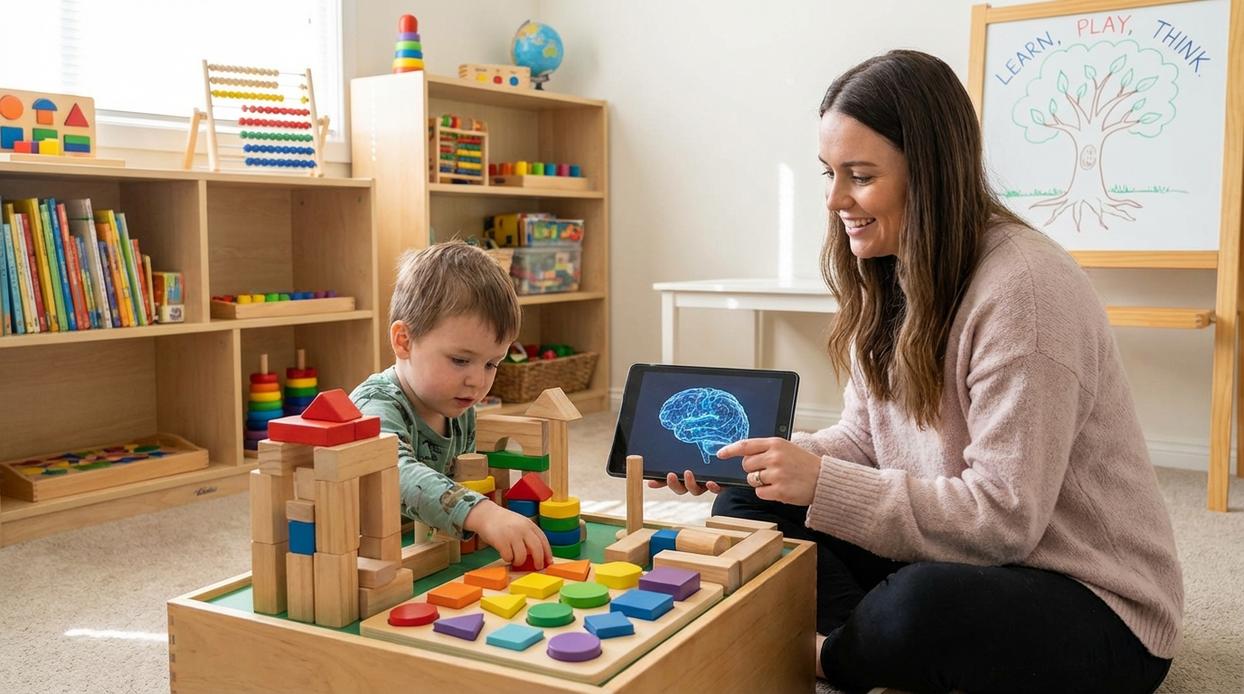
Between ages 2 and 7, something almost magical happens. Children enter what psychologist Jean Piaget called the preoperational stage, and in my opinion, it is one of the most delightful phases of childhood. Language explodes, imagination stretches, and symbols take center stage. A block is no longer just a block; it becomes a rocket ship, a sandwich, or a sleeping puppy (and you are absolutely expected to play along).
This is also when egocentrism shows up. Kids struggle to see another person’s perspective—not out of selfishness, but because their brains are still organizing cognitive milestones in children. Pretend play becomes their laboratory for learning.
I always tell parents: lean into it.
- Encourage dress-up and imaginative scenarios to stretch creativity.
- Read stories together and ask, “What do you think happens next?”
- Use counting bears or blocks to make early math hands-on and visible.
Some argue structured academics should start earlier. I disagree. Play is the work. Through make-believe, children practice empathy, language, and problem-solving. If you want to go deeper into understanding social development in early childhood, you’ll see how imagination fuels connection.
The Concrete Operational Stage
Between ages 7 and 11, children enter what psychologist Jean Piaget called the Concrete Operational Stage. In other words, this is when logic finally starts to stick. Kids begin thinking logically about real, concrete events rather than purely through imagination. Their ideas become organized, rule-based, and surprisingly rational (yes, you can actually win an argument with a third grader now).
One major shift involves understanding conservation—the realization that the amount of water stays the same in a tall, thin glass versus a short, wide one. They can also sort objects by multiple traits, like color and size, reflecting key cognitive milestones in children.
Some argue kids this age are “basically little adults.” Not quite. Their reasoning still relies on tangible examples.
To support this growth, try board games with strategy and turn-taking. Involve them in cooking to practice sequencing and measurement. Encourage collecting hobbies to strengthen classification skills.
The Formal Operational Stage
Around age 12, something shifts. Kids begin to master abstract thinking, meaning they can explore ideas that aren’t directly in front of them. In my opinion, this is one of the most exciting cognitive milestones in children because conversations suddenly get deeper (and sometimes surprisingly intense). They can debate fairness, imagine future careers, or ask, “What if the world ran out of water?”
Key milestones include thinking systematically, weighing hypothetical outcomes, and wrestling with moral gray areas. Think less playground drama, more philosophical debate.
I always suggest discussing current events or wild hypotheticals, encouraging journaling, and watching documentaries together. Even a superhero movie can spark ethical debates—yes, even Spider-Man counts.
Your search brought you here for clarity, and now you have a clear framework for understanding the amazing developmental stages of your child’s mind. While it can feel overwhelming, remember that cognitive milestones in children unfold naturally—like chapters in a well-loved story. Notice what sparks their curiosity and match it with actions: read together, ask open-ended questions, offer building blocks to strengthen problem-solving. If they’re exploring language, narrate daily routines; if they’re sorting shapes, turn it into a game. Pro tip: rotate toys weekly to keep interest high. Create a loving, stimulating environment where questions are celebrated and every milestone matters.
Helping Your Child Thrive at Every Stage
You came here looking for clarity on how to better support your child’s growth—and now you have practical strategies to guide their learning, behavior, and emotional development with confidence. Understanding cognitive milestones in children gives you a clearer picture of what to expect and how to respond in ways that truly nurture progress.
Parenting can feel overwhelming when you’re unsure if your child is “on track” or getting the right support. That uncertainty is stressful. But with the right knowledge and simple, consistent actions, you can turn doubt into direction and create an environment where your child thrives.
Now it’s time to take the next step. Start applying these strategies daily, observe your child’s progress, and stay proactive about their developmental journey. If you want trusted, research-backed parenting guidance that simplifies every stage and helps you feel confident in your decisions, explore more expert resources today and take control of your child’s growth with clarity and peace of mind.